Perishable food must be stored at 40°F (40 C) or below within two hours, or one hour above 90°F (320 C). Within refrigerator, keep raw foods separate, use shallow covered containers, and observe federal storage charts. Reheat leftovers to 165°F (740 C). To judge whether food is usable; obviously it should not be spoiled. Good food storage safety supersedes guesswork with reliable decisions about time, temperature, cross-contamination and rejecting uncertain food.
Although September is observed as National Food Safety Education Month, these habits are important and should be continued as daily routine throughout the year. According to CDC estimates published in March 2026 , every year about 48 million American people is affected by foodborne illness. This report further says that food born illnesses contribute towards 128,000 hospitalizations and 3,000 deaths. The food safety charter is simple, i.e. Clean, Separate, Cook and Chill.
Why Can Refrigerated Food Still Cause Illness?
Refrigerated food can still cause illness, because refrigeration slows many germs, but it does not sterilize food. FDA warns that pathogens can cause illness even when there is no change in food’s taste, smell or appearance. A sniff test may uncover obvious spoilage but cannot verify safety. Tasting food for checking increases exposure.
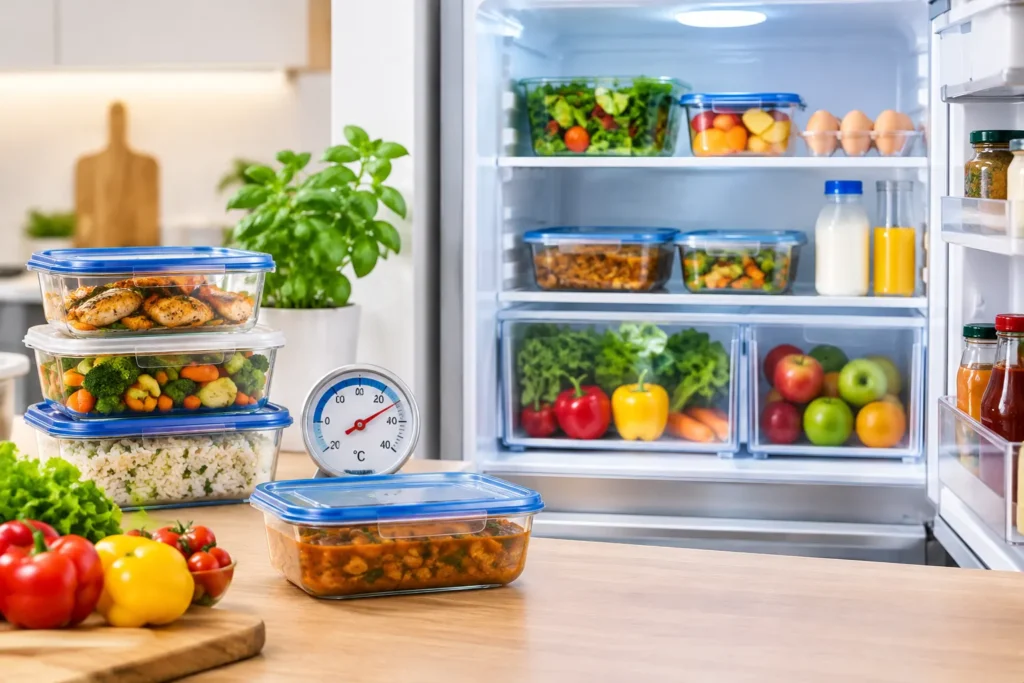
Danger range of temperature for storing food is from 40°F (40 C) to 140°F (600 C), because bacteria multiply rapidly in this temperature. CDC recommends keeping refrigerators at 40°F (40 C) or below and freezers at 0°F (-180 C) or below. An appliance thermometer is more trustworthy than the control dial.
What Are the Four Basic Food-Safety Steps?
Clean
Every kitchen should be safe and hygienic. Therefore, wash your hands with soap under running water for about 20 seconds before, during, and after cooking, and right before you eat. It is also necessary to wash down your utensils, cutting boards, and counters after every single item you prepare. Never forget to rinse your produce under running water and ensure to wipe up any spills in the fridge right away.
Separate
Raw food like meat, poultry, sea foods or eggs can easily contaminate ready-to-eat food. It is known as cross-contamination, when germs move from raw food items to cooked food. To avoid cross-contamination, it is necessary to separate them at all stages such as shopping, preparing and refrigerating. Store raw items sealed on a low shelf. Moreover, use different plates and boards for uncooked and ready-to-eat foods.
Cook
Color and texture do not determine that job is accomplished. Use a thermometer accurately. CDC provides a list of temperatures needed for different foods. CDC recommend a temperature of 165°F (740 C) for poultry, casseroles and leftovers; 160°F (710 C) for ground meats; and 145°F (630 C) plus a three-minute rest for whole cuts of beef, pork, veal and lamb.
Chill
For refrigerator food safety, it is necessary to cool promptly. Refrigerate perishables within two hours, or one hour above 90°F (320 C). If there is a large amount of food, it is advised to divide it into clean, shallow containers so that they cool faster. Small hot portions may be put directly into the refrigerator.
How Should Leftovers Be Stored Safely?
For leftover food safety, start counting time when food was taken out of safe hot or cold holding. Once food is eaten; then dispose of leftover perishables if it remains out more than two hours at room temperature, or one hour above 90°F (320 C). Beyond this safe time, bacterial growth can start and refrigeration does not reverse bacterial growth or remove some toxins.
Use shallow, covered containers and put a label indicating food and date. Leave space in the refrigerator for cold air to circulate. Put leftovers visible and freeze portions early if they will not be eaten within the refrigerator window.
FoodSafety.gov’s federal cold-storage chart recommends these home-refrigerator limits at 40°F (4.40 C) for different types of food as given below:
| Food Item | Maximum Storage Limit |
| Cooked meat or poultry leftovers | three to four days |
| Soups and stews | three to four days |
| Pizza | three to four days |
| Egg, chicken, ham, tuna and macaroni salads | three to four days |
| Raw ground meat and raw poultry | one to two days |
| Fresh beef, pork, veal or lamb steaks, chops and roasts | three to five days |
| Hard-cooked eggs | one week |
These are household safety standards. Labels and Food Keeper guidance may be more detailed. Throw the food away if time, temperature or handling history is not known.
A date label is practical only when everyone understands it. Write down the day food was cooked or opened, rather than a guessed discard date, and review the container against the applicable federal chart. For packed lunches, use insulated bags with appropriate cold sources and keep perishable foods cold until eating. Return restaurant leftovers to refrigeration quickly once you arrive at home. During grocery trips, collect chilled and frozen items near the end, transport them directly home, and refrigerate them instantly. These small routines decrease the hidden time food spends warming on counters, in cars, or inside bags each week.
Does Freezing Reset the Safety Clock?
Clear cut answer is no, because freezing pauses growth of germs but does not reliably kill every germ. It means that if the food is already contaminated, freezing will not kill the germs but can halt their growth. In other words, freeze food within its safe refrigerator period, not to rescue an old item. Label it, then allow it to unfreeze within the refrigerator, cold water or microwave, but definitely not on the counter.
FoodSafety.gov says food constantly frozen at 0°F (-180 C) remains safe indefinitely; published freezer times concern quality. Once the food unfreezes, follow refrigerator limits and cook right away when necessary.
How Should Leftovers Be Reheated?
Reheat leftovers and casseroles to 165°F (740 C), confirmed by thermometer. In a microwave, cover, rotate or stir to decrease cold spots, then let standing time. Reheat cold food before by utilizing a slow cooker for hot holding.
Reheat only the portion required. Repeated warming and cooling establish more mistakes, and reheating cannot save food left out too long.
Who Needs Extra Protection from Foodborne Illness?
CDC identifies four higher-risk groups that need extra protection from foodborne illness. These groups include:
- adults 65 and older,
- children under five,
- pregnant people
- those with weakened immune systems
About half of older adults are hospitalized with laboratory-confirmed Salmonella, Campylobacter, Listeria or E. coli are hospitalized, while pregnant people are almost 10 times more likely to develop Listeria infection.
Employ safe food storage limits predictably, don’t take higher-risk unpasteurized or undercooked foods, and observe relevant clinical guidance. Caregivers should check temperatures, dates and recalls directly.
When Should Food Be Discarded?
Discard perishables beyond accepted time limits, exposed to unsure warmth, in leaking or swollen containers, or under recall. Also discard moldy food unless authoritative guidance allows trimming that particular product. Don’t taste questionable food.
After an outage, apply federal guidance. Safety of food depends on appliance temperature, fullness and duration. Log when power failed and consult FoodSafety.gov or a local health authority.
When Should Someone Seek Medical Care?
Usual symptoms that necessitate seeking medical care contain diarrhea, cramps, nausea, vomiting and fever. CDC directs medical care for bloody diarrhea, diarrhea lasting for three days, fever above 102°F (390 C), inability to keep liquids down, or dehydration signs.
Pregnant people should also contact a clinician for fever with flu-like symptoms. Get help urgently for severe weakness, confusion, breathing difficulty, fainting or other alarming symptoms. High-risk people need individualized advice.
A Practical Kitchen Checklist
- Retain refrigerator temperature at 40°F (4.40 C) or below and freezer temperature at 0°F (-180 C) or below.
- Refrigerate perishables within two hours, or one hour above 90°F (320 C).
- Store raw meat, poultry and seafood sealed in lower compartment away from ready-to-eat foods.
- Put a label on leftovers with the date and use federal storage charts.
- Reheat leftovers to 165°F (740 C) and confirm with a food thermometer.
- Check recalls and discard food with an unsafe or unknown history.
Save This Food-Safety Checklist
Print or save the checklist where meals are prepared. Then explore Health Glow’s guides to food-poisoning prevention, safe meal preparation and food safety for children. Small systems—an appliance thermometer, date labels and a reliable discard rule—make safer decisions easier on busy days.
Medical Disclaimer
This article provides general food-safety education and does not replace advice from a healthcare professional or public-health authority. Storage guidance assumes proper handling and temperature control. Seek medical care for severe symptoms or concerns involving a high-risk person.