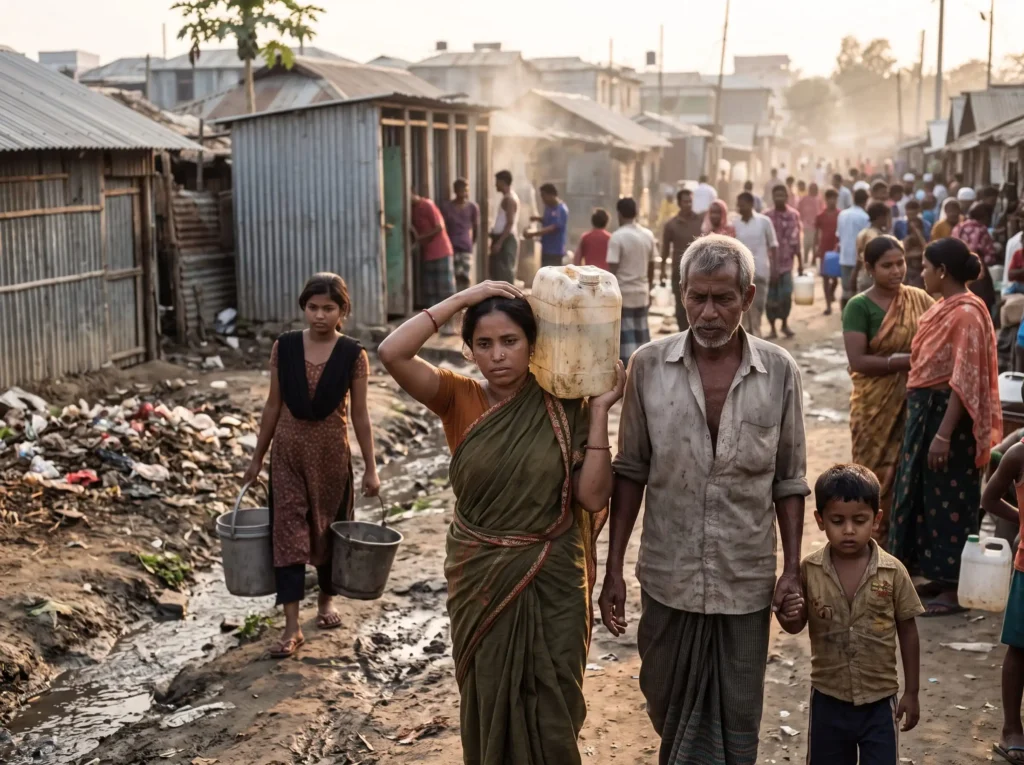
Health risks increase tremendously, beyond just inconvenience if one lives with poor sanitation. Poor sanitation means; toilets are unsafe, wastewater is untreated, hands cannot be washed consistently and much more. Communities should understand what diseases are caused by poor sanitation. They can realize it properly if they are able to trace how human waste, contaminated water, food, flies, and unwashed hands move pathogens through communities. According to the 2025 WHO/UNICEF Joint Monitoring Programme report, almost 3.4 billion people still lacked access to safely managed sanitation in 2024. Out of those 3.4 billion, there are 1.5 billion that lived without even basic services.
What Is Sanitation, and Why Does It Matter?
What is sanitation? In public health, sanitation involves systems and behaviors that safely contain, gather, transport, treat, and dispose of human excreta and wastewater. Active sanitation and sanitation facilities break the fecal-oral route. It is the fecal-oral route through which disease germs or microorganisms from feces of diseases person to reach another person through water, food, hands, surfaces, or insects.
An essential sanitation service usually implies an enhanced toilet or latrine not shared with other households. Safely managed sanitation means that in addition to an improved latrine, excreta should also be safely disposed of on-site or transported and treated off-site.
How Many People Around the World Are Lacking Proper Sanitation?
The recent WHO/UNICEF figures answer how many people around the world are lacking proper sanitation. According to this report, in 2024, just 58% of the global population had been able to use safely managed sanitation. In other words, 42% of global population (or 3.4 billion people) lacked that level of protection. Almost 560 million used public facilities, 555 million used low level facilities, and 354 million still practiced open defecation.
According to WHO estimations, about 1.4 million deaths occur each year due to ineffective water, sanitation, and hygiene.
What Diseases Are Caused by Poor Sanitation?
What diseases are caused by poor sanitation? Mostly infections spread through fecal contamination, unsafe water, food, hands, and exposure to parasite.
Important examples comprise:
Cholera from food or water which is contaminated with Vibrio cholerae.
Typhoid fever is strongly linked with unsafe water and sanitation.
Dysentery, that includes shigellosis as well as amoebic dysentery.
Diarrheal illnesses from E. coli, rotavirus, norovirus, Giardia, or Cryptosporidium.
Hepatitis A through contaminated food, water, or close contact with hepatitis a patient.
Poliomyelitis through the fecal-oral route.
Soil-transmitted helminths like roundworm, whipworm, and hookworm.
Schistosomiasis is due to poor sanitation that contaminates freshwater with parasite eggs.
Trachoma, related to insufficient hygiene and sanitation.
Other intestinal parasitic infections that impair nutrition and growth.
WHO reports approximately 1.7 billion childhood diarrheal episodes every year. These outcomes render poor hygiene diseases as an enduring global equity problem.
Diseases Caused From Dirty Water
The phrase diseases caused from dirty water indicates the infections acquired from water, contaminated by human or animal waste. Water can carry bacteria, viruses, protozoa, and parasites, remarkably when sewage contaminates drinking supplies.
Cholera can result in severe watery diarrhea and dehydration. WHO approximates 1.3 to 4 million cholera cases worldwide each year. Typhoid produces prolonged fever and systemic illness; WHO guesses nearly 9 million cases and 110,000 deaths yearly using 2019 estimates.
Therefore, safe water depends on both protection at source and sanitation. Where untreated fecal waste continues contaminating the environment, providing treated drinking water addresses only one part of the transmission chain, leaving other side to continue contaminating treated water.
10 Diseases Caused by Not Washing Hands: What the Phrase Means
Search for 10 diseases caused by not washing hands can be misleading because unwashed hands are not independently cause of disease. Unwashed hands can cause diseases because they transmit pathogens after contact with feces, respiratory secretions, food, animals, or surfaces. CDC states that handwashing helps in preventing diarrheal and respiratory infections.
Examples take account of cholera, shigellosis, norovirus, rotavirus infection, hepatitis A, typhoid, some E. coli diarrheal diseases, giardiasis, respiratory viral infections, and certain foodborne illnesses.
Useful handwashing suggests using soap and clean running water and cleaning hands at critical times, specifically after using the toilet, changing a child, managing waste, and before cooking or eating food.
Societal Impact and Poor Hygiene Diseases
The penalties of poor hygiene extend beyond clinics, i.e. in addition to pressure on health systems, the effects of diseases due to poor hygiene have other effects on health, for example:
- Repeated enteric infections can make malnutrition worse and affect child growth.
- Families may lose income
- Children miss school,
- Women and girls can face safety and privacy risks.
The factors that can damage sewage systems and contaminate water sources include floods, displacement, conflict, and climate shocks. That’s why resilient sanitation and sanitation facilities protect health, dignity, education, and economic participation while causing reduction in poor hygiene diseases.
Prevention: Breaking the Transmission Chain
A public-health response works effectively when sanitation and sanitation facilities are planned as a complete service chain instead of isolated construction projects. That means that all the systems of public health should be planned and implemented jointly, for example:
- who can safely use a toilet,
- where waste goes afterward,
- whether treatment works during floods or power failures,
- whether schools and clinics have water and soap.
The same systematic thought applies to water purification technology market growth: i.e. stronger demand for filters and treatment equipment may support safer water, but purchasing technology does not ensure protection. Water-quality testing, operator training, maintenance budgets, sludge management, and standards are still essential for public agencies. Equity is also important because households with poverty, disability, displacement, or living in remote areas frequently experience the greatest exposure and the least consistent service.
Preventing the diseases that are caused by poor sanitation involves layered protection.
Essential measures consist of:
Build and maintain toilets that safely keep feces separate and away from people.
Collect, transport, treat, and dispose of sewage or fecal sludge securely.
Prevent contamination of drinking-water sources from sewage.
Use appropriate filtration, disinfection, boiling, or other treatment when required.
Provide soap facilities for handwashing in homes, schools, workplaces, markets, and clinics.
Practice safe food processing and keep preparation surfaces clean.
Use applicable vaccines according to local recommendations.
Increase surveillance so that outbreaks are identified and controlled quickly.
Safe toilets without treatment can still pollute water.
Water Purification Technology Market Growth and Public Health
Commercial estimates of water purification technology market growth indicate rising treatment demand. Grand View Research projected the global water treatment systems market to reach about $88.0 billion by 2033, with an 8.9% CAGR from 2026 to 2033. Fortune Business Insights estimated the water purifier market at $37.7 billion in 2025, rising to $72.82 billion by 2034.
However, technology must match the contaminant. Some filters do not remove viruses and require regular maintenance.
Technology can reduce diseases caused from dirty water, but upstream sanitation remains essential. The strongest public-health approach combines source protection, treatment, safe storage, and reliable waste management.
Case Study Lessons: Infrastructure and Behavior Must Work Together
Oral rehydration, vaccination, surveillance, and household water treatment save lives, but WHO emphasizes that long-term control depends on safe drinking water, sanitation, and hygiene.
Communities remain vulnerable when septic tanks leak, sludge is dumped untreated, or handwashing stations lack soap. Effective programs connect infrastructure, operations, behavior, monitoring, and financing.
Key Takeaways
If you ask what diseases are caused by poor sanitation, think beyond a list of infections. The central problem is exposure through water, food, hands, soil, and shared environments.
For what diseases are caused by poor sanitation, three priorities matter most: safely contain and treat human waste, protect drinking water, and make handwashing with soap practical everywhere. Governments, communities, and households all need reliable sanitation and hygiene systems.
Understanding how many people around the world are lacking proper sanitation sharpens the urgency. Billions still lack safely managed services. Closing that gap can prevent disease and improve dignity.
References
WHO/UNICEF Joint Monitoring Programme (2025): Progress on household drinking water, sanitation and hygiene 2000–2024. https://data.unicef.org/resources/jmp-report-2025/
UNICEF Data: Sanitation Statistics. https://data.unicef.org/topic/water-and-sanitation/sanitation/
World Health Organization: Sanitation fact sheet. https://www.who.int/news-room/fact-sheets/detail/sanitation
World Health Organization: Diarrhoeal disease fact sheet. https://www.who.int/news-room/fact-sheets/detail/diarrhoeal-disease
World Health Organization: Cholera fact sheet. https://www.who.int/news-room/fact-sheets/detail/cholera
World Health Organization: Typhoid fact sheet. https://www.who.int/news-room/fact-sheets/detail/typhoid
CDC: About Handwashing. https://www.cdc.gov/clean-hands/about/index.html
Grand View Research (2026): Water Treatment Systems Market Growth & Trends. https://www.grandviewresearch.com/press-release/global-water-treatment-systems-market
Fortune Business Insights (2026): Water Purifier Market. https://www.fortunebusinessinsights.com/water-purifier-market-103118