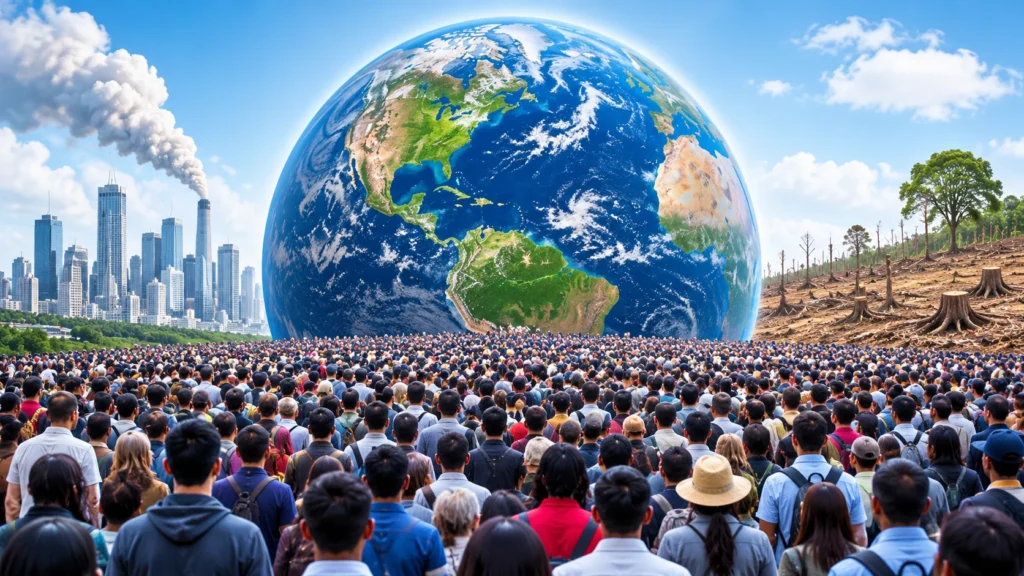
When you visit a crowded hospital, house rent becomes unaffordable, or there is a shortage of water in your city; the very first reason that strikes the mind is population growth. Contrary to common belief that the causes of human overpopulation involve births; in reality it is more than that. According to United Nations estimates the global population is almost 8.3 billion in 2026. However, at the same time, growth is slowing and populations are decreasing in some countries. It is not a matter of counting the number of people inhabit Earth; the real concern is whether communities can meet human requirements without harming ecosystems or preventing people’s opportunities. This guide separates demographic evidence from worrying headlines.
What Is Overpopulation?
People asking, what is over population? generally are looking for a simple definition; overpopulation is defined as a population where challenges for providing resources and services outpace an environment or society’s capacity to provide them in a sustainable way. This is not a universal cut-off figure that beyond that, it is overpopulation. Severe housing shortages may become a problem in a city because planning, inequality, or infrastructure investments have lagged, even if its population growth is slow. On the contrary, dense places can be supportive for healthy lives when clean water, sanitation, transport, and healthcare are consistent. Carrying capacity defines the population an environment can sustain under distinct technologies and consumption patterns; it alters when those conditions vary.
Is Planet Earth Overpopulated in 2026?
There is not scientifically supported yes or no answer for the search is planet earth overpopulated. The UN World Population Prospects 2024 predicts a highest number of roughly 10.3 billion in the mid-2080s, as compared with 8.2 billion in 2024. Its 2026 medium-variant estimate is about 8.3 billion. At the same time, the UN describes that more than half of countries and areas now have fertility below about 2.1 births per woman, the long-run alternative benchmark in low-mortality populations without migration. Any headcount-only verdict may be complicated by climate emissions, food waste, consumption, and unequal access to services. Some places encounter rapid growth, while others face declining workforces and population aging.
Main Causes of Human Overpopulation
The major causes of human overpopulation are demographic transitions interacting with local systems that cannot increase fast enough. They should not be puzzled with blame directed at distinct communities. Important factors include:
- Dropping mortality: vaccination, sanitation, safer childbirth, antibiotics, and food security allow more children and adults to survive.
- Population momentum: a larger group of people of one generation starting their reproductive age can give birth to many children even when the average number of children per family becomes smaller.
- Uneven fertility transitions: educational opportunity, access to voluntary contraception, and social protections impact desired family size.
- Rapid urban migration: movement from rural to urban areas can increase demand for housing, transportation, and water in the cities without increasing the overall national population.
- Underinvestment: weak infrastructure or inequitable distribution can make population pressure worse than numbers alone imply.
Two Things That Increase a Population
Births and immigration are two things that increase a population, while deaths and emigration reduce it. However, in a closed world population, international migration cancels out the latter factor and global numbers change through only births minus deaths. Actual increase in population at any place is births minus deaths, while net migration is arrivals minus departures. Fertility measures live births per woman on average, while a birth rate means number of births relative to the whole population. These terms are related but not the same. A country can still grow when fertility is below replacement level, but age structure or migration offsets the decline.
What Caused Overpopulation Historically?
Anyone querying what caused overpopulation should analyze the timing of the demographic transition. Agricultural enhancements supported larger settlements. Industrial-era transport and food production increased supplies, although benefits were not shared equally. During the nineteenth and twentieth centuries, developments in clean water, public health, and medicine reduced death rates before birth rates dropped across many societies. The resulting interval of fast growth was historically meaningful. According to the UN, humanity reached eight billion in November 2022; addition of another billion will take longer period that the interval of fast growth. Historical growth shows remarkable upgrading in survival, not just family size.
What Are the Reasons for Overpopulation in Particular Places?
The question of what are the reasons for overpopulation? is often concerning for local experiences instead of global averages. Main reasons for overpopulation in a particular place include:
- Housing supply may lag employment growth;
- drought can decrease available water;
- conflict can relocate families into already stressed districts.
- where girls lack education or reproductive healthcare,
- people may have less opportunities to achieve their intended family size
Poverty also changes approach to land, transport, nutritious food, and medical care. Population pressure therefore appears from both demographic change and institutions. Importantly, describing these mechanisms must never indicate coercive population policies or that certain lives have less value.
Overpopulation Examples: Different Pressures, Different Causes
Useful overpopulation examples show why context matters. Dhaka illustrates the difficulties of combining intense urbanization with drainage, transport, and housing needs. Lagos faces the challenge of matching rapid metropolitan expansion with infrastructure and employment. Meanwhile, Japan illustrates the opposite demographic challenge: an aging society and long-term population decline. These places should not be reduced to simplistic labels. Their circumstances differ in geography, migration, policy, public services, and economic opportunity. The comparison shows that population change alone cannot predict quality of life.
Environmental and Public Health Effects
Where demand surpasses sustainable capacity, communities may experience crowded housing, unsafe sanitation, groundwater depletion, habitat conversion, and deteriorating air quality. Heat exposure and infectious disease risks can rise when infrastructure is overwhelmed. However, environmental harm also depends on consumption and technology: emissions are not distributed evenly across income groups. Urban density itself is not inherently unhealthy; well-designed compact cities can provide efficient transit and service delivery. Effective responses combine pollution controls, resilient housing, environmental protection, and equitable healthcare instead of assuming that fewer births will immediately solve every problem.
Economic Costs: Healthcare, Resources, and GDP
Fast population growth can increase government spending needs for clinics, classrooms, water networks, and roads. When investment falls behind, households may pay more for private transport, treatment, or unreliable utilities. Such costs affect productivity and household savings. But more people also mean potential workers, consumers, entrepreneurs, and taxpayers. Economists distinguish total gross domestic product, or GDP, from GDP per person: a growing national economy does not guarantee improving individual living standards. The demographic dividend becomes possible when a large working-age population has access to education, healthcare, productive employment, and supportive institutions. Neither economic collapse nor prosperity follows automatically from growth.
Practical, Rights-Based Solutions
There is no single intervention that resolves population-related pressures. Public health policy should protect personal autonomy while improving the systems people depend upon. Priorities include:
- Provide accessible, voluntary contraception and reproductive healthcare without pressure or discrimination.
- Invest in girls’ education, maternal health, and economic opportunities for women.
- Upgrade water, sanitation, affordable housing, public transport, and primary care before services fail.
- Reduce food waste, improve energy efficiency, protect ecosystems, and plan for extreme weather.
- Use transparent demographic forecasts and neighborhood-level evidence rather than sensational population counters.
What Should Readers Take Away?
The causes of human overpopulation cannot be described by one statistic. Population momentum, falling mortality, fertility differences, migration, consumption, and policy choices all concern. Evaluate whether communities can sustain safe, dignified lives within environmental limits instead of asking whether a specific number of people is inherently too many. Explore Health Glow’s related public health explainers on clean drinking water, urban air pollution, and preventive healthcare. Data interpretation is also important. An estimate is not a promise, and one national average can conceal major differences between regions, income groups, and age cohorts. Public dashboards often show fast changes without explaining ambiguity, quality of census, or the distinction between a forecast and an observation.
Sources & Publication Notes
- United Nations, World Population Prospects 2024 — https://www.un.org/sustainabledevelopment/blog/2024/07/press-release-wpp2024/
- United Nations, Population overview — https://www.un.org/global-issues/population
- UN DESA, population datasets and methods — https://population.un.org/wpp/