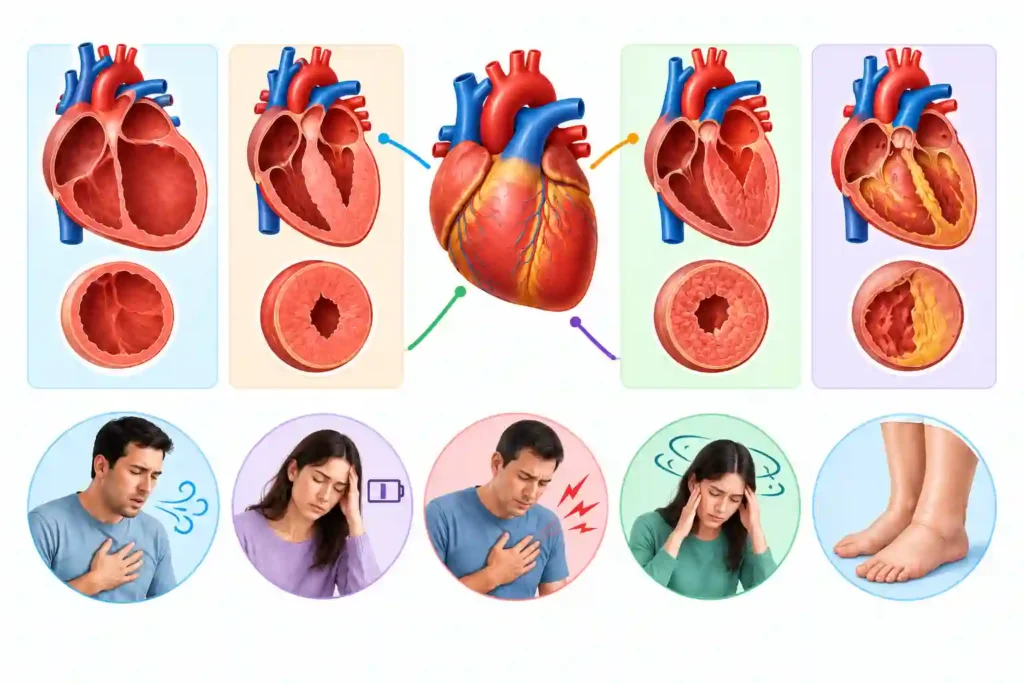
Heart failure is a slow process which develops over time. Therefore, the first change may not feel dramatic. Examples of early signs may be like:
- Suddenly becoming breathless while climbing the stairs, which are normal daily routine, and feeling like having pause before going next steps.
- Shoes worn in the morning feel tight by evening due to swelling of ankle.
- It becomes uncomfortable sleeping flat.
- Ordinary everyday jobs leave an exhaustion that rest does not explain.
Changing symptoms may indicate that the heart is straining to meet the body’s requirements.
Identifying early heart failure symptoms may initiate early evaluation. However, heart failure cannot be confirmed symptoms alone. Two cardinal symptoms described earlier, i.e. breathlessness and ankle swelling may be due to other conditions as well, for example:
Breathlessness may be due to lung disease, anemia, infection, deconditioning, or anxiety.
Ankle swelling may suggest veins, kidney, liver, medication, or mobility problems.
Observe patterns without diagnosing yourself.
What Does Heart Failure Really Mean?
Heart failure does not imply that the heart has either stopped or is about to stop working. Actually, the term heart failure is used to describe the condition that the heart cannot pump sufficient amount of blood for the body’s requirements, cannot fill normally, or both. The problem may be due to the disease of the left side, right side, or both. Some people have decreased ejection fraction, while others have preserved ejection fraction but a stiff ventricle that fills poorly. Ejection fraction means the percentage of blood that your heart pumps out of its main chamber (the left ventricle) with each heartbeat. Normal amount of blood pumped with each beat is 50-70% of blood in ventricle. Reduced ejection friction is less than 40%. Preserved ejection friction is 50% or more but ventricle has low blood due to stiff muscles.
Congestive heart failure means fluid comes out of veins and accumulates in the tissues of lower legs, showing swelling. The clinicians now use the broader term heart failure because congestion/swelling is not always noticeable. Congestive heart failure symptoms usually develop slowly, but sometimes all of a sudden becomes worse. Common causal contributors include coronary artery disease, previous heart attack, high blood pressure, valve disease, cardiomyopathy, diabetes, and abnormal rhythms.
According to CDC estimates based on 2017–2020 data, almost 6.7 million U.S. adults of age 20 years or more are affected by heart failure. The CDC also reports that in 2023, cause of death of 452,573 US people was heart failure. Death by heart failure does not mean that it was primary cause, A death-certificate mention does not mean heart failure was always the primary cause, but it shows how frequently the condition is associated with serious illness.
What Are the First Signs of Heart Failure?
The very first sign of heart failure appears in the form of loss of reserve. It means that the activities that previously had been easy to perform with comfort; now have become difficult. Usual heart failure signs are breathlessness, fatigue, swelling particularly of lower legs, and decreased exercise tolerance. None of these signs are confirmatory sign for diagnosis. However; a grouping of these signs, trends, and fast change provides more information for diagnosis.
Breathlessness with Activity or Lying Down
Shortness of breath heart failure patterns may start during hard work like severe exercise, then with progress of disease; it occurs even with lighter activity. When the left side of the heart cannot process blood efficiently, pressure can mount behind it, and fluid collects in the lungs. This makes breathing difficult.
A peculiar form of breathlessness is called orthopnea. IN this condition, some people want additional pillows or are unable to lie flat comfortably. Some people experience severe breathlessness that awakes them suddenly during sleep. A permanent cough or wheeze can occur, specifically at night. New breathing difficulty should be assessed medically because asthma, chronic lung disease, infection, blood clots, and other conditions can look similar.
Swelling and Rapid Fluid-Related Weight Change
The phenomenon of swollen ankles heart failure appears when blood returning to the heart is pooled back in lower legs. This pooling of blood results in fluid movement into tissues. Collection of fluids in the tissues appears as swelling. Swellings may be seen in both feet, ankles, or lower legs. If the swollen area is pressed, it can leave an indentation. Another place where fluid may also be collected is the abdomen. Collection of fluid in abdomen results in fullness, discomfort, diminished appetite, or nausea.
Daily weight can show fluid change before swelling becomes noticeable in someone already diagnosed with heart failure. However, there is no common number that describes danger for everyone. Track the reporting threshold provided by your care team. New swelling other than heart failure can also result from vein disease, kidney or liver problems, medication effects, injury, or prolonged sitting.
Fatigue and Reduced Exercise Tolerance
People with heart failure may complain about heavy legs, unusual weaknesses, slower walking, difficulty achieving chores, or requiring more recovery time. The reason behind these complaints is insufficient circulation of oxygen-rich blood in muscles and organs, which in turn results in fatigue during activity. Poor sleep from night-time breathing problems can make fatigue worse.
Fatigue is particularly nonspecific. Other conditions like anemia, thyroid disease, sleep disorders, depression, infection, medication effects, and many other are possible reasons behind fatigue. What matters is a continued or worsening change, specifically when fatigue appears with breathlessness, swelling, chest discomfort, or palpitations.
Other Possible Symptoms of Heart Failure Include
- A rapid or irregular heartbeat, pounding, or fluttering
- Constant coughing or wheezing
- Decreased appetite, nausea, or abdominal fullness
- Have to urinate more often at night
- Difficulty concentrating, confusion, or reduced alertness
- Cool hands and feet or decreased exercise capacity
When Are Symptoms Showing an Emergency?
The symptoms that demand emergency care include severe or sudden breathlessness; chest pain or pressure; fainting or collapse; blue or gray lips; new confusion; coughing pink, foamy sputum; or quickly worsening breathing with sweating, weakness, or nausea. Call 911 in the United States, 1122 in Pakistan or your local emergency number, for those conditions. Avoid driving yourself when emergency transport is available.
Pursue your clinician’s written action plan if you have already been diagnosed as a case of heart failure. Contact the care team quickly if breathlessness increases, wanting more pillows, new or worsening swelling, quick weight change beyond your personal threshold, increasing fatigue, or decreased response to the usual plan. Do not increase dose of diuretics or make changes in another medicine unless your clinician has given specific instructions.
How Do Clinicians Evaluate Possible Heart Failure?
Clinicians initiate evaluation by taking the history of disease symptoms, medical and family history, history of medicines, alcohol or drug exposure, pregnancy history, and conditions like coronary disease, hypertension, diabetes, kidney disease, or sleep apnea. At next step, a clinician examines blood pressure, pulse, oxygen level, heart and lung sounds, neck veins, swelling, and other findings.
An electrocardiogram (ECG) measures rhythm and electrical patterns. A chest X-ray can show heart enlargement, lung fluid, or another cause of breathlessness. Blood tests can evaluate kidney, liver, thyroid, electrolytes, anemia, and natriuretic peptides, which may emerge when the heart is under strain. The results of those tests do not diagnose because age, kidney function, body size, and other conditions affect these markers. Therefore, results should be interpreted by a clinician.
An echocardiogram applies ultrasound to investigate chambers, valves, pumping strength, filling, and ejection fraction. Depending on the suspected cause, further imaging, stress testing, coronary assessment, or rhythm monitoring may be applicable. No single symptom or test should be read in isolation.
What Does Long-Term Management Involve?
Heart failure is a chronic disorder having different causes and subtypes. Management is directed towards improvement in symptoms and function, decrease hospitalization, slow progression, and treat the causing problem. The plan may involve respective evidence-based medicines, devices or procedures, cardiac rehabilitation, and care for blood pressure, diabetes, coronary disease, valve disease, or rhythm disorders.
Daily self-management assists clinical care. It may include taking medicines reliably, attending follow-up, tracking symptoms and weight as directed, limiting sodium in a personalized way, staying appropriately active, leaving tobacco, and discussing vaccines, sleep, mood, affordability, and caregiving requirements. Fluid limits are not suitable for everyone and should come from the treatment team.
The Next Practical Step
Never wait for every textbook symptom to develop. Track significant changes in breathing, swelling, weight, stamina, sleep position, and daily function, then communicate the pattern with a clinician. Look for emergency help for red flags. Use Health Glow’s types-of-heart-disease pillar to compare heart failure with coronary artery disease and heart valve disease and prepare focused questions for your appointment.
Medical Disclaimer
This article presents general education and does not diagnose, treat, or supercede individualized advice from a qualified healthcare professional. In an emergency, call your local emergency number.