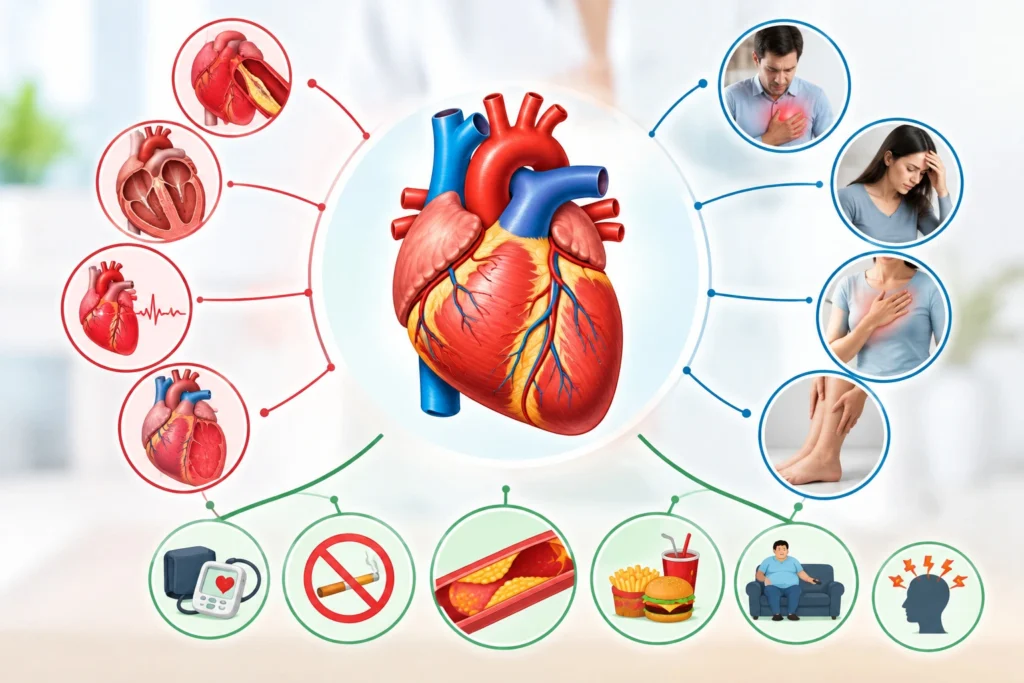
When we speak about heart disease, mostly it is misunderstood because the label sounds like one diagnosis, i.e. a particular disease. Truly speaking, the phrase heart disease implies a group of disease that affect different parts of heart such as the heart’s arteries, muscle, rhythm, valves, or pumping ability. That difference is important because:
- Breathlessness may indicate heart failure,
- Fast heartbeat may reflect an arrhythmia,
- Chest pressure may signal decreased blood flow through the coronary arteries
However, symptoms overlap, and some disease may develop silently. A symptom list can be used for a conversation, but it cannot recognize the cause.
Knowledge of the major types of heart disease supports you recognize patterns, explain changes clearly, and go for the right level of care. It is also important at population level. The CDC reports that in 2024, 683,491 people died of heart disease in U.S. This high number makes heart diseases to remain the nation’s leading cause of death in 2024. The same agency reports that 5.0% of U.S. adults had ever been assigned a diagnosis of coronary heart disease in 2024. Those numbers should not create panic; rather, they are to generate awareness among population about risks and also how to act on warning signs.
What Does “Heart Disease” Include?
Heart disease describes the conditions that affect the heart itself. Cardiovascular disease is broader term, and it also incorporates disorders of blood vessels elsewhere in the body, like stroke and peripheral artery disease. Sometimes the two terms are used interchangeably, but recognizing differences is useful when reading health information.
In the table below five common categories of heart diseases are introduced; however, they are not mutually exclusive. For example, coronary artery disease can harm heart muscle and may also result in heart failure. Similarly, cardiomyopathy can generate both heart failure and arrhythmia. A clinician therefore assesses the whole pattern instead of diagnosing the diseases with one symptom.
| Condition | What is affected | Possible symptoms | Important risk factors | Common diagnostic approaches |
|---|---|---|---|---|
| Coronary artery disease | Arteries supplying blood to heart muscle become narrowed or blocked | Chest pressure, breathlessness, fatigue; sometimes without any symptom | High blood pressure, high cholesterol, smoking, diabetes, age, family history | History, examination, blood tests, ECG, stress testing, coronary imaging |
| Heart failure | Heart cannot fill or pump blood well enough for the body’s requirements | Breathlessness, fatigue, swelling, fast weight gain | Coronary disease, high blood pressure, diabetes, valve disease, cardiomyopathy | Examination, blood tests, ECG, echocardiogram, chest imaging |
| Arrhythmia | Heart’s electrical timing or pathway | Palpitations, missed beats, dizziness, fainting, breathlessness | Heart disease, age, thyroid problems, sleep apnea, medications, stimulants | ECG, ambulatory monitor, blood tests, echocardiogram |
| Heart valve disease | One or more valves do not open or close normally | Breathlessness, fatigue, chest discomfort, fainting, swelling | Aging, congenital defects, infection, rheumatic disease, prior heart damage | Examination, echocardiogram, ECG, chest imaging |
| Cardiomyopathy | Heart muscle becomes enlarged, thickened, stiff, or scarred | Breathlessness, fatigue, swelling, chest pain, palpitations, fainting | Genetic variants, family history, infections, toxins, pregnancy-related changes, other disease | History, ECG, echocardiogram, cardiac MRI, blood tests; sometimes genetic evaluation |
Tests vary according to symptoms, urgency, age, history, and examination findings.
1. Coronary Artery Disease
Coronary artery disease (CAD): They are also termed as coronary heart disease. When plaque builds up in arteries that deliver oxygen-rich blood to the heart muscle, it leads to decreased blood flow that can cause angina (pain in chest that may be relieved after some time); however, sudden blockage can cause a heart attack. According to the CDC coronary artery disease (CAD) is the most common U.S. heart-disease type.
Typical concerns are pressure, squeezing, heaviness, or discomfort in the chest, unusually with exertion or stress. Discomfort may involve an arm, shoulder, jaw, neck, back, or upper abdomen. Breathlessness, unusual fatigue, nausea, sweating, or light-headedness can appear. However, ischemia (low blood supply) can be silent, and presentations differ among individuals. Absence of classic chest pain does not eliminate the possibility of CAD.
Risk increases with high blood pressure, raised cholesterol levels, smoking, diabetes, physical inactivity, and older age. Diagnosis is done considering a combination of different tests: an ECG, laboratory tests, stress testing, coronary CT angiography, or invasive angiography. Practically, no single test suits everyone.
2. Heart Failure
Heart failure does not imply that the heart has stopped. It means that the capacity of the heart is low enough to pump sufficient blood or to fill normally, or both. It may disturb the left side, right side, or both, and ejection fraction may be decreased or preserved. The CDC calculate approximately that about 6.7 million U.S. adults aged 20 or older have heart failure.
Frequent heart failure symptoms incorporate breathlessness during activity or while lying flat, decreased exercise tolerance, constant fatigue, swelling in the feet or legs, abdominal fullness, and quick weight gain from fluid retention. A cough or waking short of breath can appear. These symptoms also have other causes, not related to heart; therefore, new or worsening changes justify assessment instead of self-treatment.
Main contributors towards heart failure include CAD, long-standing high blood pressure, previous heart attack, diabetes, valve disease, and cardiomyopathy are. Clinicians may use an examination, natriuretic-peptide blood testing, ECG, chest X-ray, and echocardiography for diagnosis.
3. Arrhythmia
Arrhythmia is a problem related to heart rate or rhythm. It means that the heart may beat too fast, too slowly, or irregularly. Some types of rhythm changes are short lived and harmless; others decrease blood flow or increase the risk of stroke, heart failure, or sudden cardiac arrest. A well-known example is atrial fibrillation, but many types of rhythms exist.
Possible symptoms involve fluttering, pounding, racing, missed beats, dizziness, weakness, chest discomfort, breathlessness, or fainting. Some arrhythmias cause no obvious symptoms and are discovered only during an examination or ECG.
Evaluation often begins with a 12-lead ECG. A Holter monitor, event recorder, or longer-term monitor may be necessary because abnormal rhythms can come and go. Blood tests can distinguish contributors like electrolyte or thyroid abnormalities, while an echocardiogram evaluates structure and function. There is a range of treatment that starts from observation and trigger management to medication, cardioversion, catheter ablation, or even an implanted device.
4. Heart Valve Disease
In heart valve disease, one or more of the heart’s four valves become:
- too narrow (known as stenosis),
- fail to close fully (known as regurgitation),
- develop another structural problem
Valve disorders can be congenital i.e. present from birth. Other causes of valve disorders include aging, infection, rheumatic disease, or damage due to other heart conditions.
Symptoms may involve decreased stamina, breathlessness, chest discomfort, dizziness, fainting, palpitations, or swelling. Severity of the disease cannot be determined dependably from symptoms alone: major valve disease may initially be silent, while similar symptoms may be due to lung disease, anemia, or other causes.
A clinician may hear a murmur through stethoscope; however, a murmur itself does not automatically mean dangerous disease. Echocardiography is main test for diagnosis because it displays valve anatomy, blood flow, and heart response. Close monitoring may be adequate for some people; others need medication for correlated problems, valve repair, or valve replacement. Valve severity, symptoms, and effects on the heart determine timing for intervention.
5. Cardiomyopathy
Cardiomyopathy implies that heart muscles are diseased. Cardiomyopathy may be dilated, hypertrophic or restrictive. Introduction of each type is as follows:
Dilated cardiomyopathy: a chamber becomes enlarged and contracts weakly.
Hypertrophic cardiomyopathy: It causes abnormal thickening of heat muscles.
Restrictive cardiomyopathy: It makes the muscle stiff, and arrhythmogenic forms involve substitution of muscle with scar or fatty tissue.
Causes of cardiomyopathy may be inherited or acquired, and sometimes due to unknown reason.
Although myopathy disease at early can be asymptomatic, but at later stage, the condition may create breathlessness, fatigue, swelling, chest pain, palpitations, dizziness, or fainting. Family history matters, specifically unexplained sudden death, cardiomyopathy, heart failure at a young age, or recurrent fainting. That history should be told to a clinician.
Testing may contain ECG, echocardiography, cardiac MRI, blood tests, and rhythm monitoring. Genetic counseling or testing may be suitable in selected families, but explanation needs expert guidance. Treatment is adjusted to the form, symptoms, rhythm risk, and pumping function.
Shared Risk Factors—and What Prevention Can Change
Every condition cannot be prevented. Some influencing factors such as age, inherited variants, congenital differences, and some infections cannot be changed. Nevertheless, controlling adjustable risks can decrease the probability or complications of several conditions.
- Realize your blood pressure, cholesterol, and blood-glucose results and discuss what they mean for you.
- Prevent tobacco and look for evidence-based help to quit if you use it.
- Build regular movement, balanced eating, restorative sleep, and weight-neutral health goals into a reasonable plan.
- Take prescribed medicines as directed and discuss side effects before stopping them.
- Continue follow-up appointments if you have diabetes, kidney disease, sleep apnea, or an existing heart condition.
- Tell clinicians about family history, pregnancy complications, medicines, supplements, and substance use without embarrassment.
When Symptoms Need Emergency Care
Call 911 in the United States, or your local emergency number, for new chest pressure or pain lasting more than a few minutes or returning; chest symptoms with breathlessness, sweating, nausea, weakness, or discomfort in an arm, jaw, neck, back, or stomach; severe breathing difficulty; collapse; or fainting with chest pain or palpitations. Do not drive yourself if emergency transport is available.
Also treat sudden facial droop, one-sided weakness or numbness, speech difficulty, confusion, vision loss, severe unexplained headache, or loss of balance as possible stroke signs. Note when symptoms began and call emergency services immediately. Heart and vascular emergencies are time-sensitive, and waiting for certainty can delay treatment.
The practical Takeaway
Realizing the types of heart disease is effective when it results in better questions, faster identification of emergencies, and earlier attention to controllable risks. It is not a replacement for assessment by a clinician. If symptoms are new, changing, or unexplained, record the pattern and speak with a qualified healthcare professional. Study Health Glow’s guides to coronary artery disease, heart failure, arrhythmia, heart valve disease, and cardiomyopathy to prepare for that conversation.
Medical Disclaimer
This article grants general education and does not diagnose, treat, or swap individualized medical advice. In an emergency, call your local emergency number.