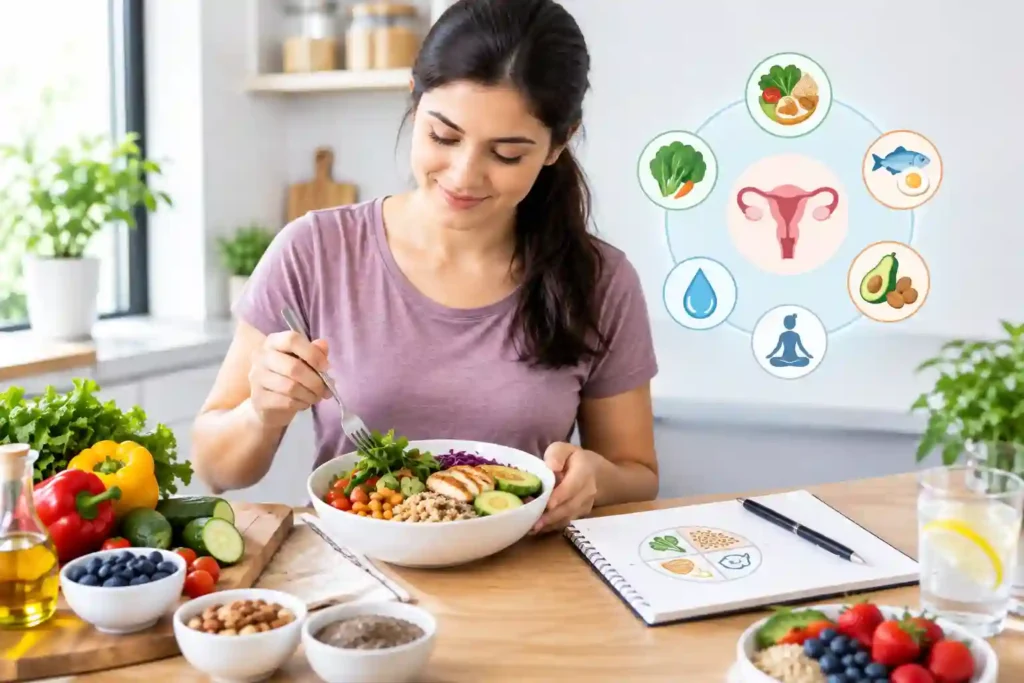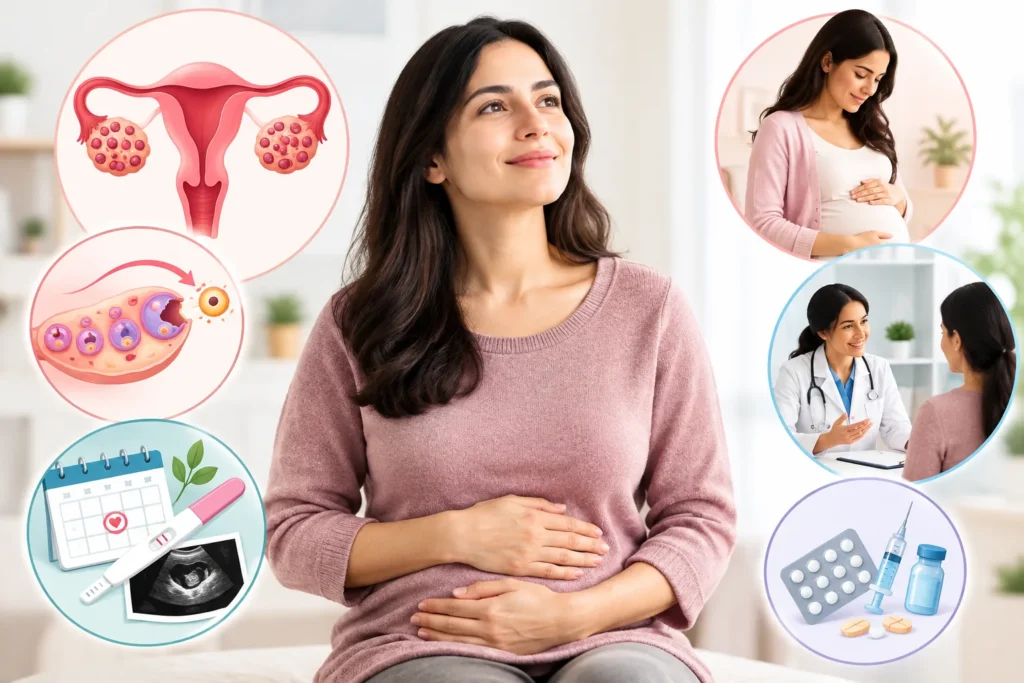
This document describes how polycystic ovary syndrome (PCOS) can affect ovulation and fertility. It also discusses in detail when to look for medical evaluation, steps of preconception care, and probable treatments such as ovulation induction. It talks with the readers who desire to know about PCOS and fertility, PCOS infertility, PCOS ovulation, getting pregnant with PCOS, and fertility treatment PCOS. It helps those readers by presenting them evidence-based, structured guidance to navigate cycle unpredictability and explore clinical options confidently.
Trying to conceive can change an irregular cycle into a monthly guessing game like:
- Was there an ovulation window?
- Was the timing wrong, or did ovulation not occur?
Uncertainty often becomes a challenging symptom for people who are navigating PCOS and fertility. The reality that can reassure them is the fact that PCOS does not mean permanent infertility. Many people with PCOS conceive without fertility treatment, while others may require structured evaluation and support.
Quick Answer: Can People with PCOS Get Pregnant Naturally?
Yes, people with PCOS can get pregnant naturally. Spontaneous pregnancy is possible with PCOS, specifically when ovulation occurs. PCOS can cause ovulation irregular or absent. It decreases the number of predictable opportunities for an egg and sperm to meet, but it does not automatically inhibit conception.
PCOS is prevalent enough that this question concerns many U.S. families. A July 2026 report from the CDC’s National Center for Health Statistics observed that 8.7% of women ages 20–49 had ever been diagnosed of having PCOS in 2022–2023. Separately. CDC also reported that 13.7% of U.S. women ages 20–49 had ever used any fertility service in 2022–2023. Neither figure can forecast an individual outcome, but both statistics show why accessible fertility conversations are important to be done in time.
How Does PCOS Ovulation Affect Conception?
Ovulation means the release of a mature egg from an ovary. Hormone signals naturally organize follicle growth, egg release and preparation of the uterine lining. In PCOS, ovulation may occur occasionally or not at all, because there is higher androgen activity and subsequently varied signaling can interfere with follicle development.
Long, random cycles can mean less ovulations over a year. They can also make calendar apps erratic because those tools are often developed considering a regular cycle. Bleeding is not the proof of ovulation, and vice versa, the absence of a textbook mid-cycle symptom does not verify that ovulation did not occur.
Home luteinizing-hormone tests can help some people; however, PCOS can make confusing or repeatedly positive results. Basal temperature tracking proves a temperature shift only after ovulation, but this can be affected by sleep or illness. While determining whether ovulation is occurring, depending on the situation; a clinician may employ menstrual history, blood testing or ultrasound.
Does PCOS Infertility Involve Only Ovulation?
PCOS infertility does not involve only ovulation always. Irregular ovulation may be the most apparent issue, but a complete fertility assessment prevents the assumption that PCOS explains everything. Conception can also be affected by a number of other reasons that include age-related egg changes, semen factors, blocked fallopian tubes, endometriosis, uterine conditions, thyroid disorders, medications and timing.
That is the reason that both partners, when pertinent, should be considered early. Testing one person for a long time before arranging a semen analysis can delay an answer. Assessment should be individualized, because every patient does not need every hormone test, imaging study or procedure. Similarly ovarian “cysts” on ultrasound do not measure fertility.
When Should Fertility Help Be Considered?
Typical guidance often recommends assessment after 12 months of regular unprotected intercourse when the person trying to conceive is younger than 35. For people 35 or older, this evaluation is recommended after 6 months. However, consultation earlier than above is suitable when there is:
- very irregular or absent periods,
- a known fertility-related condition like PCOS,
- a history suggesting tubal or uterine disease,
- recurrent pregnancy loss,
- a possible sperm concern.
Also request for care earlier if periods stop for quite a few months when pregnancy is not the explanation, or if there is severe pelvic pain, very heavy bleeding or another worrying symptom. Those worries need evaluation whether pregnancy is currently a goal or not.
What Is Relevant in Preconception Care?
Preconception care is larger than ovulation. A clinician may examine blood pressure, glucose status, medicines and supplements, immunizations, mental health, sleep, substance use and family history. PCOS is accompanying heightened metabolic and pregnancy-related risks, but an individual’s risk is more dependent on their health and circumstances.
Discuss folic acid before conception; the proper dose may differ for exact medical or medication situations. Examine every prescription, over-the-counter medicine and supplement instead of stopping essential treatment alone. There are some medicines, which are used for acne, androgen symptoms or weight management; such are not suitable during pregnancy or require advance planning.
Nutrition and movement should support nourishment, strength and metabolic health, rather than punishing the body into ovulating. If weight change is a shared clinical goal, it should be managed without stigma and with rational support. People of all body sizes have the right of fertility, evaluation and treatment.
What Treatments May Help PCOS-Related Infertility?
A fertility treatment PCOS search cannot determine care; options depend on ovulation and factors. The following are categories for discussion, not instructions for self-treatment.
Ovulation Induction
For anovulatory infertility due to PCOS with no other infertility factors, the 2023 International Evidence-based PCOS Guideline recommends letrozole as first-line pharmacological treatment. Availability, labeling and clinical suitability vary by country and patient. Other oral ovulation-induction medicines may be considered in some settings.
Treatment requires professional oversight because timing, contraindications, pregnancy exclusion and response are also important. Monitoring approaches differ. No one should borrow medication or change a dose using an online protocol.
Insulin-Sensitizing Treatment
A clinician may discuss metformin for metabolic indications and, in selected fertility contexts, as part of an ovulation strategy. It is not a universal fertility drug, and the relative benefits of other ovulation-induction options should be explained. The decision should reflect glucose health, symptoms, side effects, pregnancy plans and the full evaluation.
Gonadotropins and Procedures
Injectable gonadotropins may be considered after first-line oral treatment in appropriate cases. They require closer monitoring because multiple follicle development can increase the chance of multiple pregnancy and ovarian hyperstimulation. A specialist explains the expected benefits, burden, cost and risk.
In vitro fertilization may be considered when other treatments have not worked or when additional factors make it appropriate. IVF is not automatically required for PCOS. Treatment plans may use strategies to reduce ovarian hyperstimulation risk, which can be higher in PCOS.
Surgery
Laparoscopic ovarian surgery is now a selected, largely second-line option instead of routine treatment. Potential benefits should be weighed against surgical risks and the likelihood of affecting ovarian tissue. It is not like removing the harmless follicles often seen on ultrasound.
What Can Improve the Quality of a Fertility Visit?
Bring (preferably written) record of cycle dates, history of previous pregnancy, appropriate test results, a medicines-and-supplements list, and the duration and pattern of trying. Note whether periods occur less than about eight times per year or fade away for long intervals. If using home tests, bring the pattern instead of a single isolated result.
Beneficial questions include:
- Do you think I am ovulating, and how will we evaluate that?
- Should both partners be assessed now?
- Are tubal or uterine tests suitable before treatment?
- What result will tell us this plan is working?
- What are the risks, monitoring needs, costs and choices?
- When would you recommend the referral to a reproductive endocrinologist?
Emotional Health Belongs in Fertility Care
Timed intercourse, repeated tests and doubt can affect intimacy, work and mental health. PCOS is also accompanying higher rates of anxiety and depression. Feeling upset does not mean someone is coping badly; it means the burden merits recognition.
For more context, read Health Glow’s PCOS symptoms and diagnosis pillar, the guide to PCOS and irregular periods, and the evidence-based discussion of PCOS weight gain. These resources can assist organize questions without turning symptoms into self-diagnosis.
A Grounded Next Step
If cycles are irregular, do not wait for the perfect app forecast. Plan a preconception or fertility conversation, bring a concise (preferably) written record of cycle and health history, and ask what should be assessed before treatment. Getting pregnant with PCOS may demand patience and/or clinical help, but the plan should be evidence-based, tailored and honest about uncertainty.
Medical disclaimer: This article gives general education and does not diagnose infertility, confirm ovulation or recommend an individual medication or fertility protocol. Request personalized advice from a qualified reproductive-health professional, specifically for absent periods, concerning symptoms, pregnancy planning or decisions about fertility treatment.
References
- CDC/NCHS. Endometriosis, Polycystic Ovary Syndrome, and Uterine Fibroids in Women Ages 20–49: United States, 2022–2023 (28 July 2026). https://www.cdc.gov/nchs/data/hestat/hestat121.htm
- CDC/NCHS. Use of Fertility Services in Women Ages 20–49 in the United States: 2022–2023. Data Brief 542 (December 2025). https://www.cdc.gov/nchs/products/databriefs/db542.htm
- NICHD. Polycystic Ovary Syndrome (PCOS). Updated 2 July 2026. https://www.nichd.nih.gov/health/topics/pcos
- NICHD. Fertility Treatments for Females. Updated 8 January 2026. https://www.nichd.nih.gov/health/topics/infertility/conditioninfo/treatments/treatments-women
- ACOG. Good Health Before Pregnancy: Prepregnancy Care. https://www.acog.org/womens-health/faqs/good-health-before-pregnancy-prepregnancy-care
- ASRM. Fertility Evaluation of Infertile Women: A Committee Opinion. https://www.asrm.org/practice-guidance/practice-committee-documents/fertility-evaluation-of-infertile-women-a-committee-opinion-2021/
- International PCOS Network. Recommendations From the 2023 International Evidence-based Guideline for the Assessment and Management of PCOS. https://integration.asrm.org/practice-guidance/practice-committee-documents/recommendations-from-the-2023-international-evidence-based-guideline-for-the-assessment-and-management-of-polycystic-ovary-syndrome/